

Ever since humanity began to evolve, there was always the hope to see beyond. We evolved and achieved things once thought impossible including reaching the Moon's surface.
The Apollo Program
In the midst of the Cold War, two superpowers the United States and the Soviet Union competed not just on Earth, but for space. The Apollo Program became NASA's bold answer to this cosmic challenge. Between 1961 and 1972, NASA orchestrated one of humanity's greatest achievements, transforming what seemed like science fiction into reality.
The program culminated in 11 successful crewed flights with 6 Moon landings, each mission pushing the boundaries of human capability. Against a backdrop of political tension and technological uncertainty, engineers, scientists, and astronauts worked together to accomplish the impossible. On July 20, 1969, Neil Armstrong's first steps on the lunar surface proved that human determination could overcome even the vast emptiness of space. The Apollo Program wasn't just about beating the Soviets it was about proving what humanity could achieve when united by a common goal.
"That's one small step for a man, one giant leap for mankind." — Neil Armstrong
We're Going Back
It has been over 50 years since Apollo 17's last Moon landing in 1972. Now, we are going back to the Moon.
The Artemis Program, NASA's Moon exploration initiative that began in 2017, aims for scientific discovery, technological advancement, and learning how to live and work on another world, ultimately preparing for human missions to Mars. The program is divided into major missions: Artemis I through IV.
Testing the New Giant
Artemis I, an uncrewed flight test of the Space Launch System and Orion spacecraft, launched on November 16, 2022. This successful mission demonstrated the potential of NASA's new rocket system. The Space Launch System stands 98 meters tall and produces about 39 million newtons of thrust at liftoff making it the most powerful rocket NASA has ever built, designed specifically to send humans and heavy cargo directly to the Moon.
The Journey We're About to Witness
Artemis II will be the first crewed flight test of the Space Launch System and Orion spacecraft around the Moon, scheduled to launch no earlier than March 6, 2026. This 10-day journey represents humanity's return to deep space after more than half a century.
The mission profile is carefully choreographed: After launch, the crew will spend approximately two days in Earth orbit, thoroughly checking the spacecraft and its life support systems. Once everything is verified, they'll embark on a four-day journey to the Moon. The crew will fly on a figure-eight trajectory extending more than 370,000 kilometers from Earth, passing 7,400 kilometers beyond the Moon, taking the crew farther from Earth than any previous human mission.
Unlike the Apollo missions, this will be a lunar flyby rather than a landing. The crew will have the unique opportunity to observe the Moon's far side from a higher vantage point, testing critical systems like Orion's environmental controls, navigation, and communications in deep space. This mission will also validate the heat shield's ability to protect the crew during reentry. After their historic flyby, they will reenter Earth's atmosphere at approximately 40,000 kilometers per hour before splashdown in the Pacific Ocean.
The Fantastic Four
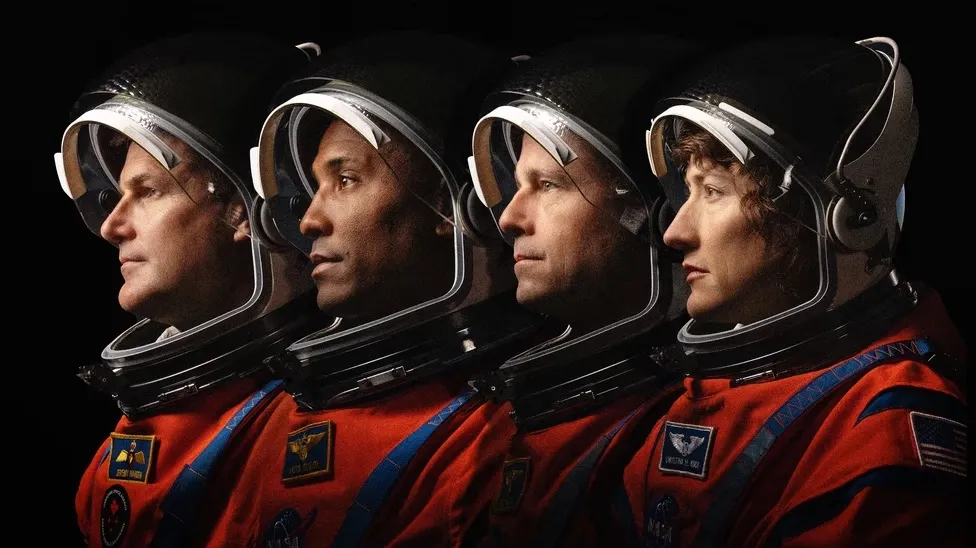
The Artemis II crew consists of NASA astronauts Reid Wiseman (Commander), Victor Glover (Pilot), Christina Koch (Mission Specialist), and Canadian Space Agency astronaut Jeremy Hansen (Mission Specialist)
Beyond and Forward
After Artemis II proves that humans can safely travel to the Moon and back, NASA plans for Artemis III to send the first humans to explore the region near the lunar South Pole by 2028. This landing will mark the first time humans have walked on the Moon since 1972 and will focus on a region never before explored by astronauts.
But the vision extends even further. Artemis IV will introduce humanity's first lunar space station, the Gateway orbiting the Moon. This orbital outpost will serve as a staging point for lunar surface missions and as a testbed for the technologies needed for the ultimate goal: sending humans to Mars. The Artemis program isn't just about returning to the Moon, it's about learning to stay there, building the foundation for an era of sustained exploration that will ultimately carry humanity to Mars and beyond.
The journey begins with Artemis II and the four brave astronauts who will blaze the trail back to the Moon.
Did you enjoy this issue?
Discuss on Signal